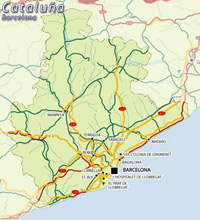
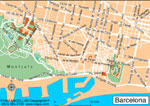
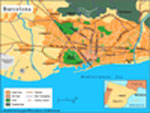
The City of Barcelona (metro area population 3
million) is situated on the Mediterranean coast
of Spain in the autonomous region of Catalonia.
After Madrid, it is the second urban-industrial
centre in Spain, and the capital of Catalonia.
|
|
Since hosting the 1992 Olympics, the city has engaged
in an ambitious programme of urban redevelopment, seeking
to position itself as the economic and cultural capital
of the Mediterranean. The latest activity is to host
the "Forum of Cultures 2004", an event that
effectively completes the strategy of refocusing the
city's development towards the sea.
Although Barcelona has acquired a reputation as a progressive
European capital and a model of urban renaissance worthy
of replication by cities around the world, such aspirations
overshadow ongoing conflicts. A century or more of continuous
urban transformation has led to the physical clearance
of entire neighbourhoods, displacement, and intense
feelings of resistance in some parts of the city.
Barcelona has a fascinating and complex history, which
contributes to its geographical significance. Barcelona
began life as a Roman settlement of secondary importance
to Tarragona, a city further to the South, which served
as the capital of the Roman colony of Hispana Citerior.
Students have the opportunity to visit Tarragona and
explore its impressive Roman acqueduct and amphitheatre,
and the walled city. After Roman occupation ended, Barcelona
began to develop as a mercantile trading port and by
the fourteenth century had become a major centre for
Mediterranean commerce. However, the influence of Madrid
meant that Barcelona did not fully capitalise on its
medieval prosperity. In the nineteenth century, the
city was industrialised and became, as one historian
put it, 'the Manchester of the Mediterranean'. At this
point, the city in an economic sense turned its back
on the sea.
Urban expansion involved the annexation of surrounding
villages and the taming of surrounding natural landscapes.
In order to show off its modern industry and progressive
culture, Barcelona hosted international expositions
in 1888 and 1929. This was also the period of modernisme,
an architectural and design movement perhaps best represented
by the works of Antoni Gaudi, such as Parc Güell
and another of his spectacular yet unfinished masterpieces,
the church of La Sagrada Familia.
If Gaudi's work represented elite interests in
the cultural development of the city, Barcelona
also became a place of cultural and economic resistance
to new social and political orders.
|
|
|